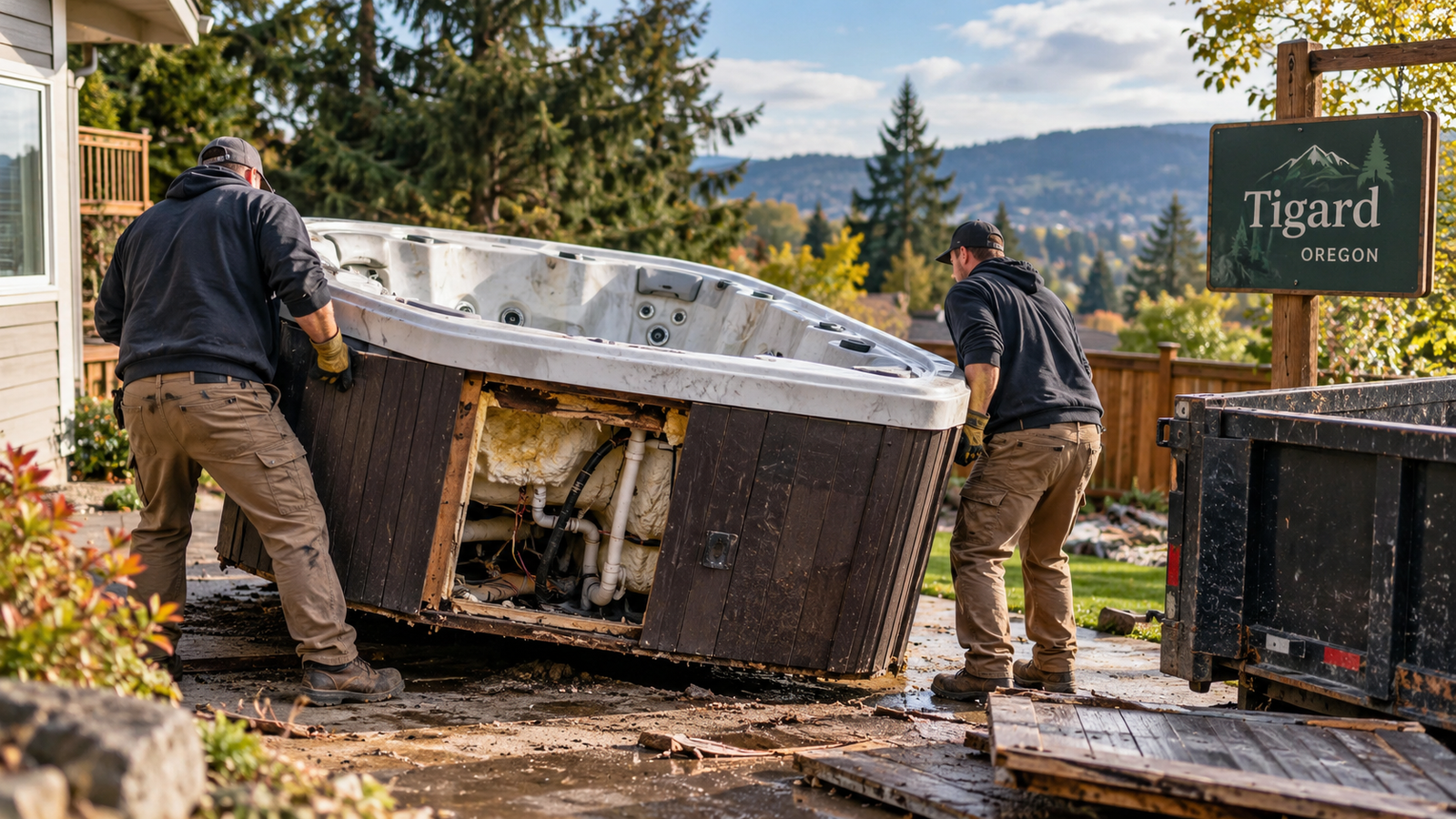
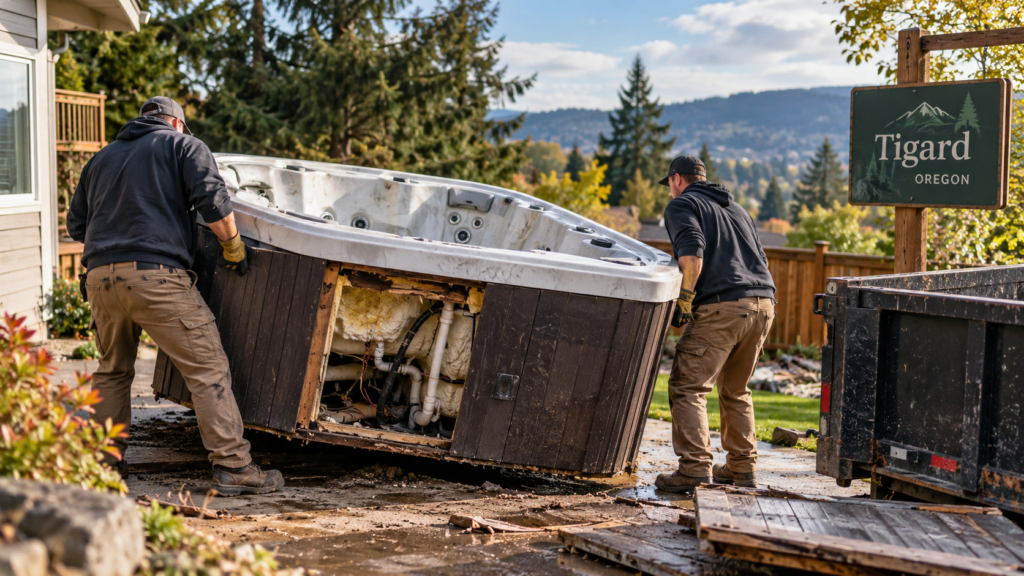
A hot tub on a Tigard backyard deck or patio is a pleasant amenity until it isn’t. The pump fails. The acrylic shell cracks. The energy bills from an aging, inefficient unit no longer make sense. The deck is being rebuilt. The house is being sold. The new owners don’t want it. Whatever the reason, the moment a Hot Tub Removal Tigard transitions from backyard feature to unwanted obstacle is the moment Tigard homeowners begin to understand a simple truth: a hot tub is dramatically easier to acquire than to remove. What arrived on a flatbed and got lifted into place by a delivery crew becomes, once it’s aged into the deck and the landscape, a substantial removal project that requires planning, the right disconnection sequence, physical labor, and responsible disposal. This guide explains what hot tub removal in Tigard actually involves from start to finish, why it cannot simply go to the curb or into a standard dumpster, and how the process flows when handled professionally.
Why Hot Tubs Are Unusually Difficult to Remove
The removal difficulty of a hot tub comes from the combination of several physical characteristics that make it unlike almost any other household item. Weight is the first factor. A standard portable spa the freestanding acrylic and wood-cabinet units that sit on most Tigard decks weighs 400 to 800 pounds empty. Add the residual water retained in the insulating foam that lines the cabinet interior (foam that absorbs and holds water over years of use) and the operational weight can exceed 1,000 pounds. This weight cannot be moved by hand across a typical residential property, and it is far beyond what a standard pickup truck or enclosed trailer can safely carry in one piece.
Size compounds the weight problem. A typical six-person hot tub measures 7 to 8 feet on each side and stands 3 to 4 feet tall. Moving this box through a gate, around a corner, and across a yard to where a truck can access it is the physical puzzle that every hot tub removal crew must solve before anything else. Many Tigard residential properties have the hot tub on a deck that was built or modified after the spa was installed, with no gate or access point wide enough to roll it out intact. The removal crew must either disassemble the hot tub into sections small enough to carry through the available opening or remove part of the fence or deck to create an exit path.
The materials that make up a hot tub acrylic shell, polyurethane foam insulation, wood framing cabinet, fiberglass, PVC plumbing, copper and stainless steel fittings, electric motor pumps, control boards, and miscellaneous hardware cannot simply be dumped as a unit. Oregon Metro’s waste management framework, which governs disposal in the Portland metropolitan area including Tigard, emphasizes material diversion from landfill. Responsible hot tub removal in Tigard involves breaking the unit into its component materials and directing each to the appropriate destination: metal components to scrap recycling, acrylic shell and plastic components to appropriate facilities, wood framing to wood recycling, and foam insulation (which is difficult to recycle) to landfill disposal as a last resort.
The Electrical Disconnection: The Step That Cannot Be Skipped
Before any physical handling of a hot tub begins, the electrical supply must be completely and verifiably disconnected. This is not a step that can be done partially or assumed it must be confirmed as complete before any crew member touches the unit. Standard portable hot tubs in Tigard operate on a dedicated 240-volt, 50-amp circuit. This is a significantly higher voltage and current than a standard household outlet, and contact with live 240-volt wiring is a life-threatening hazard.
The correct disconnection sequence is: turn off the GFCI breaker at the main electrical panel that serves the hot tub circuit, confirm at the panel that the breaker is in the off position, and verify at the hot tub’s control panel that the unit is receiving no power. Professional removal crews verify that the circuit is dead using a voltage tester before proceeding with any disassembly. If a homeowner is managing the disconnection themselves before the removal crew arrives, they should shut off the dedicated breaker at the panel and lock it or tape it in the off position so it cannot be inadvertently switched back on.
The conduit and wiring that runs from the electrical panel to the hot tub remains in place after the spa is removed unless the homeowner has engaged an electrician to cap or remove the circuit. Most Tigard homeowners leave the circuit in place if there is any possibility of installing a replacement spa, or have it capped and decommissioned if the space will be used for other purposes. What happens to the circuit after removal is a separate decision from the removal project itself, but one that should be planned before the removal is scheduled.
Draining the Hot Tub Before Removal
A hot tub must be fully drained before removal. Moving an undrained hot tub even one that appears nearly empty is impractical because of the weight of residual water and because the water would create a mess during transport. The Tigard drainage approach for a hot tub is straightforward for properties with a sewer cleanout accessible near the spa: attach a submersible pump or use the spa’s own drain to empty the water to the sanitary sewer, not the storm drain. In the Portland metropolitan area, discharging spa water to a storm drain is prohibited storm drains lead directly to waterways without treatment, and the chemicals used to maintain spa water (chlorine, bromine, pH adjusters) should not enter Oregon’s waterways.
For hot tubs where access to the sanitary sewer is not convenient, the water can often be discharged to the lawn or landscape in managed quantities, allowing it to infiltrate the soil rather than running off. The sanitizer concentrations in properly maintained spa water at the time of draining are generally low enough that this approach is acceptable for small drains onto grassed or vegetated areas, but the guidance of Washington County’s stormwater program should be consulted for any large-volume discharge near sensitive waterways. The Fanno Creek watershed that drains through much of Tigard is a water quality-sensitive area, and responsible discharge practices in Tigard should reflect this.
Tigard’s seasonal weather also affects draining planning. The Pacific Northwest’s wet season which brings consistent rainfall from October through May means that hot tubs on uncovered decks and in yards are exposed to significant rainwater accumulation. A spa that has been out of service and sitting open during Tigard’s wet season may hold hundreds of gallons of rainwater in addition to any residual operational water. This accumulated water must be managed before removal, adding time and pumping work to the pre-removal process.
The Physical Removal Process: Disassembly vs. Intact Removal
Once the hot tub is drained and electrically disconnected, the removal crew assesses the best approach for getting the unit off the property and into the truck. There are two primary approaches, and the choice depends on site access.
Intact removal moving the hot tub as a single unit using dollies, furniture skates, or a pallet jack is possible when the access path from the spa’s current location to the truck is wide enough and clear enough to allow the full-size unit to pass through. Gate openings of 36 inches or more, adequate deck structural support for the weight of the loaded equipment, and a clear path without significant grade changes or obstacles make intact removal feasible. In Tigard’s typical residential neighborhoods which include both older established properties with narrow access and newer planned developments with more generous lot layouts access conditions vary widely.
Disassembly on site is required when intact removal is not feasible. This involves cutting the hot tub into sections using reciprocating saws and circular saws removing the cabinet panels, cutting through the foam insulation, detaching the plumbing and pump components, and reducing the acrylic shell into sections manageable enough to carry through the available access. Disassembly takes longer than intact removal but is the only option when access is constrained, and it is ultimately what allows material separation for responsible recycling.
Professional removal crews assess the site before committing to either approach, typically during an initial walkthrough that informs the scope and timing of the project. Tigard homeowners can facilitate this assessment by measuring their gate openings, noting any overhanging structures or landscaping that constrains the removal path, and identifying whether any deck sections might need temporary removal to create access.
Material Destinations After Hot Tub Removal in Tigard
Oregon Metro’s regional waste management framework, within which Tigard operates, establishes clear expectations for material diversion from landfill. Responsible hot tub removal in the Tigard area routes each material stream appropriately.
Metal components the pump motors, control panel components, stainless steel hardware, copper plumbing fittings, and the structural steel frame if present go to scrap metal recycling. These materials have established recycling pathways in the Portland metropolitan area and avoid the landfill entirely. A typical hot tub contains 50 to 100 pounds of metal in various forms, all of which has recycling value.
Wood cabinet material the cedar, redwood, or composite framing panels that encase most portable hot tubs can often be directed to wood recycling. Clean, unpainted wood has more recycling options than painted or treated wood. The condition of the wood after years of moisture exposure in the Tigard climate varies wood in good condition may have value as firewood or be acceptable at wood recycling facilities, while deteriorated wood typically goes to landfill.
The acrylic shell is the most challenging component from a recycling standpoint. Acrylic plastic (PMMA) is technically recyclable but not widely accepted at standard residential recycling facilities. Specialty plastic recyclers can process acrylic shells in some cases, and the removal service’s knowledge of available facilities in the Portland area determines how much of this material can be diverted from landfill.
Foam insulation the spray-applied polyurethane that fills the cabinet interior to retain heat is almost universally directed to landfill, as recycling infrastructure for this material type is not broadly available. It represents a significant volume fraction of the hot tub but is relatively light.
What Happens to the Pad or Deck After the Hot Tub Is Gone
After the hot tub is removed, the concrete pad, reinforced deck section, or slab that supported it remains. Deciding what to do with this surface is a separate consideration from the removal itself, but one that affects what the homeowner wants to communicate to the removal crew before the project begins.
If the pad or deck section is in good condition and the homeowner wants to repurpose the space, it typically stays in place and the removal scope ends with the spa gone and the area swept clean. If the concrete pad is cracked, has settled unevenly, or is no longer wanted in its current location, concrete demolition and haul-off can often be added to the removal scope either by the same crew if they have the capability or by a separate concrete demolition service engaged alongside or after the spa removal. In Tigard’s frequently rain-soaked landscape, a concrete pad left in an unused area can create drainage pooling if it was designed to direct water toward the spa rather than away from the area. Post-removal drainage assessment is worth considering for pads that will be left in place but repurposed for a different outdoor use.
Common Questions About Hot Tub Removal in Tigard
Does curbside garbage collection in Tigard pick up hot tubs? No. Tigard’s two franchise haulers Pride Disposal and Waste Management do not accept hot tubs through standard curbside collection. Hot tubs are too large and too heavy for standard collection routes and contain materials that require specific handling. Professional hot tub removal service is the appropriate channel.
Can a hot tub be donated rather than disposed of? If the hot tub is functional and in reasonable cosmetic condition, resale through platforms like Facebook Marketplace or Craigslist, or transfer to a new owner who arranges their own pickup, are options that avoid disposal entirely. Donation to a Tigard-area organization is generally not practical because thrift and reuse organizations do not typically accept hot tubs due to transportation and electrical compliance challenges. If resale is not successful, professional removal and responsible disposal is the path forward.
How long does hot tub removal take in Tigard? A typical hot tub removal by a professional crew in Tigard takes two to four hours from arrival to site cleared, depending on the disassembly requirements and site access conditions. Properties with difficult access narrow gates, deck-mounted units, hillside yards take longer. The pre-draining of the spa (done by the homeowner before the crew arrives) reduces on-site time.